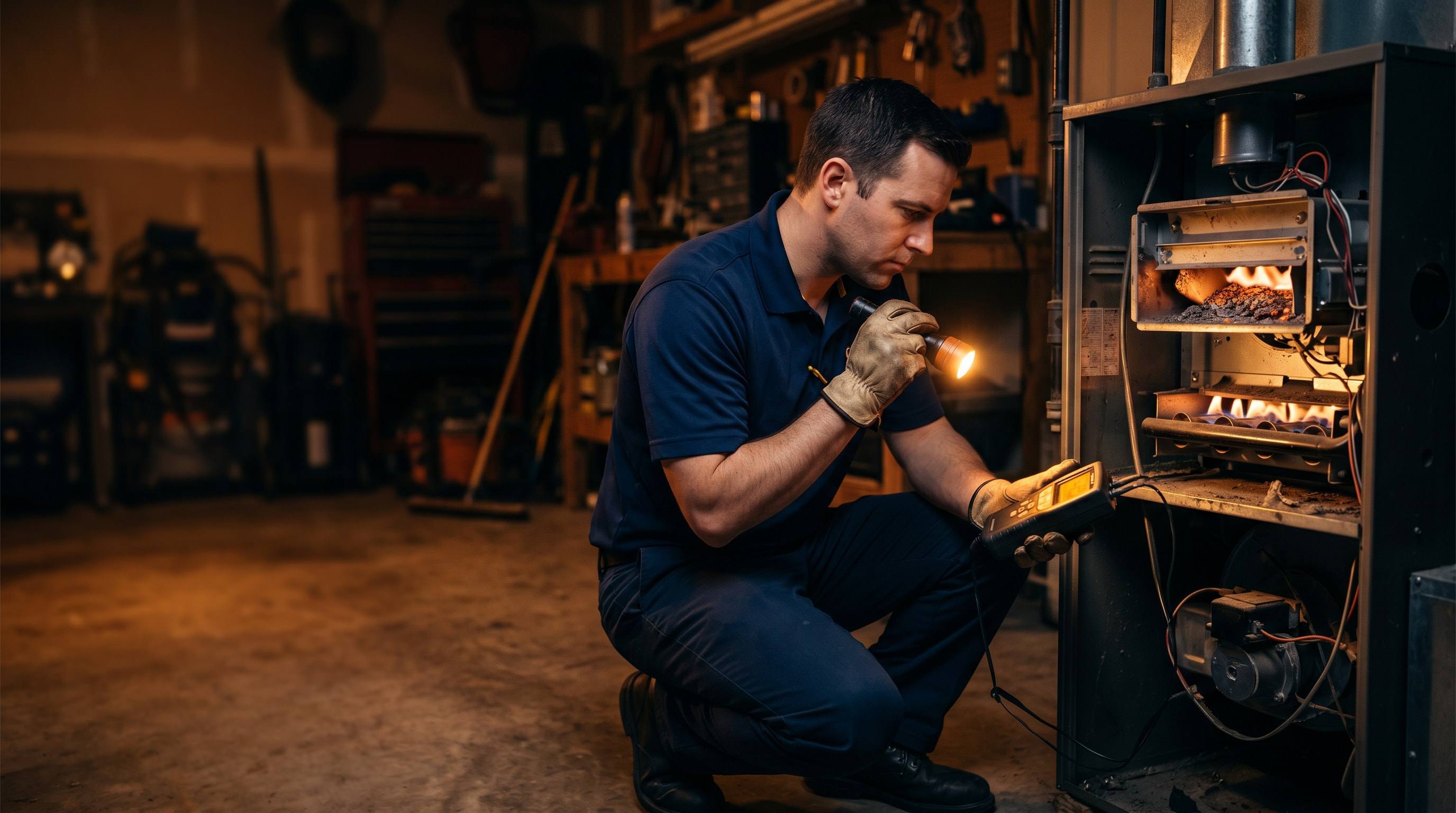
This is the failure-mode companion to our main furnace repair service. The hot-surface ignitor is the part that glows red-hot to light your burners, and it is the most common single-component furnace fault we see, especially on the first cold morning of the year.
What a hot-surface ignitor does — and how it fails
When the thermostat calls for heat, the control board powers the ignitor, which heats to over 2,000°F in a few seconds and glows bright orange-white. The gas valve opens, the gas crosses the glowing element, and the burners light. The ignitor then shuts off and the flame sensor takes over to prove the flame is still there.
The failure mechanism is wear. Every ignition cycle heats and cools the brittle ceramic element, and over hundreds of cycles it develops micro-cracks until it either snaps or no longer reaches ignition temperature. Two material types exist — older silicon-carbide (the fragile flat-paddle style) and modern silicon-nitride (a more durable rod) — and they are not interchangeable. A cracked ignitor sometimes still glows dimly, which fools homeowners into thinking it is fine; it is not generating enough heat to light gas reliably.
Signs your ignitor is the problem
- Blower and inducer run, no flame. The startup sequence completes but the burners never light.
- Ignition lockout. On a furnace with a status LED, three failed light attempts trigger a lockout code.
- Dim, uneven, or no glow visible through the burner sight glass during the ignition attempt.
- Furnace blows cold air because the blower runs but there is no flame heating the exchanger.
The trap is that all of these overlap with a fouled flame sensor, a closed gas valve, or a pressure-switch fault. A dim glow points at the ignitor; a normal glow that lights then drops out points at the flame sensor. The full decision tree is on our furnace won’t ignite page.
Ignitor replacement pricing
Flat-rate, parts and labor, from our SoCal service tickets. Diagnostic is $89 ($149 after-hours), credited to the repair if you proceed:
| Repair | Typical cost |
| Diagnostic (waived with repair) | $89 / $149 after-hours |
| Hot-surface ignitor | $245–$485 |
| Flame sensor (if also fouled) | $185–$295 |
| Gas valve | $385–$685 |
| Control board | $480–$950 |
Why ignitors fail on the first cold night in SoCal
A Southern California furnace runs only 200–500 hours a year — against 1,500-plus in a cold climate — and sits idle from spring through October. The ignitor does not wear from heavy use here; it ages quietly and then fails on the first hard call of the season, when an eight-month-idle furnace is asked to fire cleanly for the first time in months. That is why our ignitor calls spike in the first cold snap of November across the Valley, Pasadena, and the foothills. Mountain installs in Big Bear and Wrightwood run real heating hours and wear ignitors on a faster, more conventional curve. Either way, catching a marginal ignitor during a fall tune-up beats an emergency no-heat call — see fall furnace maintenance and our furnace ignitor failure deep-dive.
DIY or call us
An ignitor is mechanically simple — often two screws and a plug — but it is brittle ceramic that fails early if you touch the element with bare fingers, and the wrong type or plug will not work. More important, it lives in the burner compartment of a gas appliance, so a misdiagnosis leaves you reassembling a furnace that still will not heat. Changing your own filter is reasonable; an ignitor we would rather confirm with a resistance reading and install correctly. Gas furnace internals are licensed work for good reason.
Repair or replace
Under about 15 years old and otherwise sound, replace the ignitor — it is a cheap fix on a furnace with life left. Past 15–20 years, especially on a standing-pilot unit where the ignition system and heat exchanger are all aging together, we run the repair figure against a replacement quote so you are not pouring money into one part of a furnace that needs several. Honest math, both numbers side by side. See furnace repair vs. replace and furnace installation.
Every major brand
We replace ignitors on Carrier, Trane, Lennox, Goodman, Rheem, York, and the rest. The brand-specific no-heat diagnosis lives on the brand pages — Carrier, Trane, Lennox, Rheem, Goodman, and York furnace not heating.
Frequently asked questions
How much does it cost to replace a furnace ignitor? +
A hot-surface ignitor replacement runs $245–$485 in Southern California, flat-rate, parts and labor. Our $89 diagnostic ($149 after-hours) credits to the repair if you proceed. The part itself is $25–$90 at a supply house; the rest is the diagnostic confirmation, removing the burner-compartment panel, matching the correct ignitor (silicon-nitride and silicon-carbide are not interchangeable), and verifying a clean ignition sequence afterward. We carry the common ignitors for the eight most-installed furnace lines in SoCal on every truck, so most are a single same-day visit.
What are the signs my furnace ignitor is bad? +
The classic sign is the blower and draft inducer run through the startup sequence but no flame ever appears, so the burners never light and the furnace either blows cold air or shuts down. On a furnace with a status LED you often get an ignition-lockout code after three failed trials. Sometimes you can see the ignitor through the sight glass: a healthy hot-surface ignitor glows bright orange-white within seconds, a failing one glows dim, uneven, or not at all. A cracked silicon-nitride ignitor sometimes still glows but no longer reaches ignition temperature. We confirm with a resistance reading rather than guessing.
Can I replace a furnace ignitor myself? +
Mechanically it is one of the simpler furnace parts — usually two screws and a wiring plug — but there are real traps. Hot-surface ignitors are brittle ceramic and the skin oils from your fingers can cause hot-spot failure if you touch the element, so they are handled by the ceramic base only. You also have to match the exact ignitor type and the plug; the wrong one either will not seat or will fail early. And because the ignitor lives in the burner compartment of a gas appliance, a misdiagnosis means you are reassembling a gas furnace that still does not work. We are comfortable with homeowners changing a filter; an ignitor we would rather confirm and install correctly.
How long does a furnace ignitor last? +
A hot-surface ignitor typically lasts 4–7 years, and in Southern California they often fail right at that range on the first cold call of the season. The element degrades a little with every on-off cycle as it heats to over 2,000°F and cools, until it finally cracks or no longer reaches ignition temperature. Short-cycling from a dirty filter accelerates the wear because it multiplies the number of ignition cycles. That is part of why a fall tune-up that catches a marginal ignitor before the first cold snap is cheaper than the emergency call during it.
Why won’t my furnace ignite even after a new ignitor? +
Because the ignitor is not the only thing in the ignition chain. If a new ignitor glows correctly but the burners still will not light or will not stay lit, the next suspects are a fouled flame sensor (the furnace lights then drops out after a few seconds), a closed or failing gas valve, or a pressure-switch or draft fault that stops the sequence before ignition. A control board can also fail to send the right signal. This is exactly why we diagnose the whole sequence rather than parts-cannon a single component. See our furnace won’t ignite diagnostic guide for the full tree.
What is the difference between a hot-surface ignitor and a pilot light? +
A pilot light is a small standing gas flame that burns continuously and lights the burners directly — the older standing-pilot design common in pre-2000 SoCal homes. A hot-surface ignitor is the modern electronic replacement: a ceramic element that glows red-hot on demand to light the burners, then shuts off. Electronic ignition uses no gas between cycles, which is roughly 7–10% less gas than keeping a pilot burning year-round, and there is no thermocouple to fail. If your furnace has a standing pilot instead of an ignitor, the pilot-light troubleshooting guide is the one you want.
Is it worth replacing the ignitor on an old furnace? +
Usually yes if the furnace is under about 15 years old and otherwise sound — a $245–$485 ignitor on a furnace with cabinet and heat-exchanger life left is an easy call. Where we pause is a furnace past 15–20 years, especially a standing-pilot unit, where the ignitor (or thermocouple) is one of several aging parts and the heat exchanger itself is near end of life. There we run the repair figure against a replacement quote so you decide on real numbers rather than fixing one part on a furnace that needs three. We tell you honestly which side of that line you are on.